
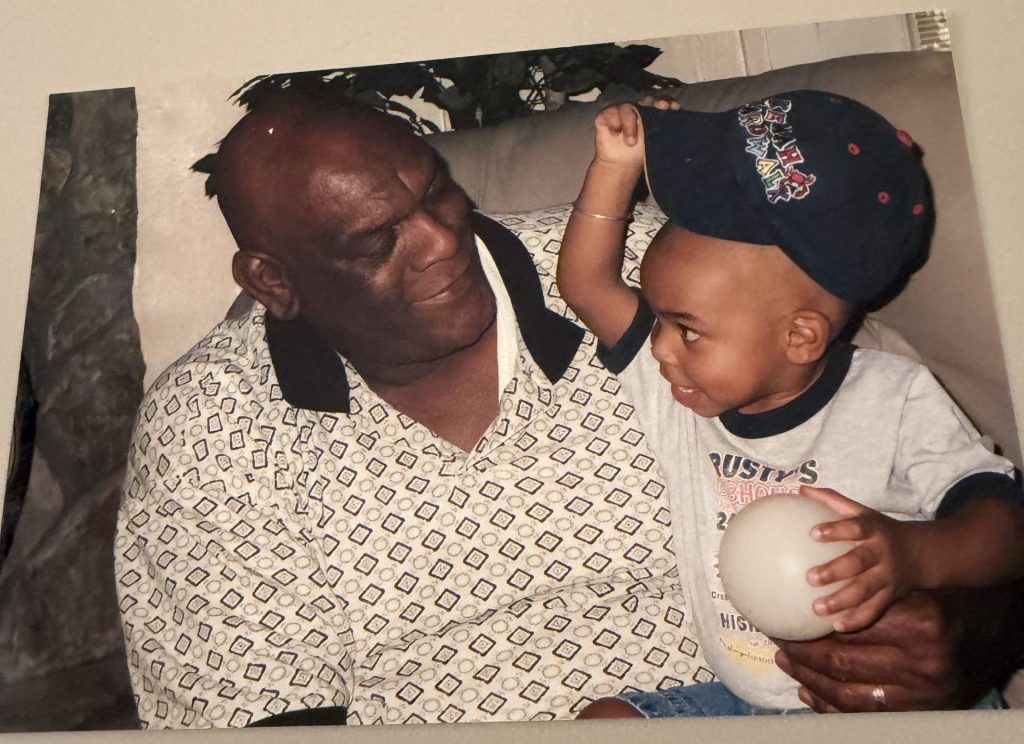
Basketball great Lucious Jackson (left) enjoys time with his infant grandson, Ashton Smith, in a family photo taken around 2007. Jackson, a San Marcos native, won an NAIA title at Pan American College in 1963, a gold medal in the 1964 Olympics at Japan and a 1967 NBA title with Wilt Chamberlain and the Philadelphia 76ers. He died in 2022. Smith, now a 6-9, 265-pound power forward, is entering his first season at UTSA. – Photo courtesy of Nicole Jackson
By Jerry Briggs
Special for The JB Replay
One of the most legendary basketball players in the state of Texas still speaks to UTSA power forward Ashton Smith.
Even though Lucious Jackson died four years ago this week at the age of 80, Smith, 23, can still hear the voice of the man who once started alongside Wilt Chamberlain on the 1960s-era Philadelphia 76ers.
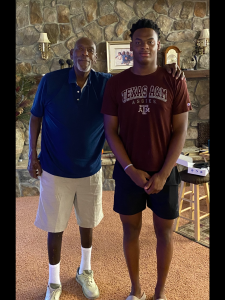
Former NBA great Lucious Jackson (left) poses with his grandson, Ashton Smith, formerly a student-athlete at Texas A&M. Smith has also attended Oral Roberts in Oklahoma and the University of South Dakota. He signed with UTSA in July. – Photo courtesy of Nicole Jackson
“Like, even now, today, I still talk to him,” Smith said of his late grandfather. “All the time. He’s not with us anymore. But in my heart, he is.”
The man that ‘60s era Sixers fans knew as “Big Jack,” or” Big Luke,” was always known as just “Papi” to his grandkids.
One of them being Smith, a 6-foot-9, 265-pound graduate student who is entering his first season with the Roadrunners.
“He never got to see me play in college,” Smith said. “But, when I committed (at Texas A&M in the 2021 signing class), I committed on his birthday. So he’s like one of the biggest role models in my life as far as basketball goes.”
After Jackson retired from the NBA in 1972, he returned home to Texas and lived in Beaumont, where he became the city’s parks director for more than 25 years.
Soon after he stepped down from his job with the city, Smith was born in 2006, and it was the start of a lasting relationship.
Living in the Houston area, Smith relished the road trips to Beaumont to see his grandparents, Lucious and Marva.
Family photographs depict a loving atmosphere, with “Papi” grinning at his infant grandson, who is alternately shown throwing a ball, frolicking in a backyard swimming pool or just lounging around in the living room.
A special moment for Smith, as a young child, came out of the blue.
“One day in his house,” he recalled, “(my grandfather) showed us his 1964 gold medal from the Olympics … I think he was still in college (when he won it). The thing was heavy, too. I also saw his championship rings.
“As a kid, you don’t really understand it. (Not) until I got to be an adult and a grown man (did I realize) the things he accomplished.”
Growing up in the 1950s in San Marcos, Jackson started his hoops journey during a time of momentous social change in Texas.
In 1954, the Supreme Court’s decision in Brown vs. Board of Education declared that segregation in public schools was unconstitutional.
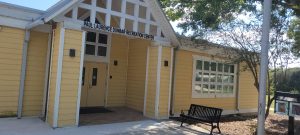
The Paul Dunbar Recreation Center in San Marcos sits on the site that once housed a school for black children before integration. Former NBA star Lucious Jackson attended school here in the 1950s, according to a marker on the grounds. – The JB Replay
By the late ‘50s, the ruling started to affect Jackson, a burgeoning blue-chip basketball prospect.
The school system in the city about 50 miles north of San Antonio started to integrate, meaning that Jackson would move from an all-black campus into San Marcos High School, apparently for his freshman year.
Published accounts claim that because of “racial politics” at the time, he never played at the school and elected to move out of state, to Bastrop. La., to get his education in a setting where he could also hone his athletic skills.
Decades later, as Jackson was installed in the Louisiana Sports Hall of Fame, he opened up to writer Keith Prince about getting snubbed as a teenager.
“I was deeply hurt and confused,” Jackson told Prince, for a story published in conjunction with his 1998 induction. “My early childhood left an impression on my mind that will always remain with me. First in elementary school, then junior high and then going into high school, I was told to sit on the sideline and watch.”
Nicole Jackson, Smith’s mother and the former NBA standout’s oldest daughter, said in a telephone interview earlier this week that her father was allowed to practice but couldn’t play as he entered high school in San Marcos.
She confirmed that her father moved to Louisiana to play for three years at Bastrop’s Morehead High School. Jackson said her father moved in with the school principal.
Lucious Jackson told Prince in 1998 that he initially resisted making the move, but his mother urged him to do so.
“I know that had to be scary, leaving his family, going to another place to play basketball,” Nicole Jackson recalled.
“But,“ Jackson said, “my dad was tough. So he stuck (it) out and he made it. He made it for himself. That’s all I can tell you. Daddy made it. From where he came from … you know, he never forgot.”
In the end, she added, “he did go out and (make) a life for himself. Took his skills to college. Took his skills to the NBA. To the Olympics. And everything paid off for him.”
After high school, Jackson played one year at Texas Southern University in Houston, before transferring to Pan American College in 1961-62.
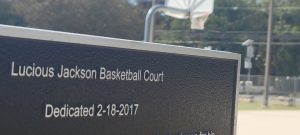
A basketball court in San Marcos at Dunbar Park is named after Lucious Jackson, who wasn’t allowed to play for the local high school in the city in the late 1950s after integration, according to the marker. – Photo by The JB Replay
At the school in Edinburg, now known as UT Rio Grande Valley, he flourished as one of the first black players at a non-historically black campus in the state, becoming a three-year All-American, all while leading the Broncs to the 1963 NAIA title.
In ’64, after leading Pan Am to the NAIA finals, Jackson’s career soared into a different stratosphere.
Named to a U.S. Olympic team that included forward Bill Bradley and guard Larry Brown, he helped the USA to the gold medal. The team won the tournament with a victory over the Soviet Union in Japan.
Upon his return, Jackson began an eight-year career with the 76ers, who featured the likes of Chamberlain, for years the NBA’s all-time scoring leader, along with Chet “The Jet” Walker, Hal Greer, Wali Jones and Billy Cunningham.
In 1966-67, they eliminated the perennial champion Boston Celtics from the playoffs and then won the NBA title.
Memorably, “Big Luke” produced 13 points and 21 rebounds in the team’s title-clinching victory over Rick Barry and the San Francisco Warriors.
“Luke Jackson goes up for a rebound ready to fight the world,” former Celtics guard K.C. Jones once said. “If Chamberlain doesn’t get it first, Jackson sure will.”
In a recent interview on campus at UTSA, Smith marveled at everything his grandfather accomplished despite the challenges.
“When I was younger, we didn’t get into (his hard times),” Smith said. “Going to grandma and grandpa’s house was all fun and stuff like that. But when I finally got older and was able to understand, my mom kind of told me everything that happened.”
Like Lucious Jackson, Smith’s journey in basketball has also been marked by ups and downs and rough patches of adversity.
Late last year, for instance, as he entered his second season at the University of South Dakota, he was slammed with three traumatic experiences in the span of about a month.
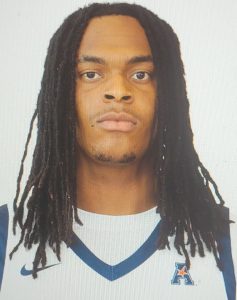
UTSA power forward Ashton Smith is working hard to return to full-contact status coming off rehabilitation from a torn Achilles tendon, suffered last December at South Dakota. – Courtesy photo from UTSA
First, his father died around Thanksgiving.
Derrick Smith, who played three years for Pat Foster at Houston in the early 1990s, passed away after an illness and a bout with congestive heart failure.
Next, Ashton Smith suffered a season-ending torn Achilles on Dec. 4. To cap off the misery, his paternal grandmother, Brenda Aaron, died on Christmas Eve.
In the aftermath, the former Houston area schoolboy standout at the Legacy School of Sport Sciences entered the transfer portal in the spring and eventually signed with the Roadrunners in July.
Smith isn’t at full speed yet. But UTSA officials are optimistic that he’ll be ready to play, if not by a Nov. 2 season opener at San Jose State, then surely during the two-month, non-conference portion of the schedule.
“I really have not seen a lot of guys attack their injuries the way he’s done it,” UTSA coach Austin Claunch said. “It’s (because of) his maturity and how he’s approached it every single day. He has been really, really impressive.
“We’re going to make sure we’re cautious with him. Obviously, he’s a great athlete. He’s got a great body, and we’re going to need that athleticism and toughness and experience, especially when we get into league play.”
Nicole Jackson, who played center at North Texas from 1988-91, said she’s proud of how her son battled through his Achilles rehabilitation, doing all the hard work during a time when he was also grieving the loss of his two family members.
“Ashton has grown tremendously since he’s been in college,” Jackson said. “But for him to go through the injuries, losing his dad and a month later also losing his grandmother … He wasn’t (even) able to come home for (the holidays, for Thanksgiving or Christmas).
“You know, he stayed up there and he pushed through it, even though I’m pretty sure he had some difficult times.”
During his college career, Smith has attended Texas A&M (2021-23), Oral Roberts University in Oklahoma (2023-24) and South Dakota (2024-26), with mixed results.
Recruited to A&M by coach Buzz Williams, he didn’t get into a game for the Aggies. His best year came at South Dakota in ’24-25 when he shot 56 percent from the field and had season averages of 4.8 points and 3.4 rebounds.
Currently, he’s optimistic about the coming season, perhaps his last in college, because his teammates are close and play together. “Like family,” Smith said.
“There’s no hate on the team,” he added. “Every time someone’s down, we pick ‘em up. That’s the team we want to be. Like, I would go to war for these dudes. For everybody. That’s the way you should feel about a team.“
In a wide-ranging interview, Smith fielded one question that seemed to catch him off guard.
Given the close bond that he had with his grandfather, he was asked what it would mean to him if the Roadrunners could pull off a surprise this season.
Granted, they have the lowest-payroll in the American Conference. They’re picked to finish last in the preseason coaches’ poll.
But, what if — during the 60th anniversary of Lucious Jackson winning the NBA championship – they could conjure up a little magic in some sort of a special season?
Smith acknowledged that it would be “amazing.” Sitting outside the coaches’ offices, his eyes seemed to light up at the thought of a winning season, or, dare he dream even bigger, a championship.
“Does that kind of fire you up?” he was asked.
“Yeah it does,” he said. “I got to call my mom and tell her about that.”
As a program, the Roadrunners are down, way down, having posted 20 or more losses in four of the last five seasons. So, floating any kind of optimism around the fan base is naturally met with skepticism.
Then again, who in their right mind would have figured that “Big Luke” Jackson would emerge from segregated schools and a poor neighborhood in San Marcos in the late 1950s to reach the Olympic Games and the NBA Finals in the ‘60s?
What would he think about the plight of the present-day Roadrunners? Or, about the chances that his grandson could have a breakout year to close his career?
“You know, he (had) a hard upbringing,” Smith said of his grandfather. “I was fortunate enough … to be blessed as a child, coming from (a family) with him and my mom. You know, they raised me. My grandma (too). My grandfather. My mom and dad. They all raised me to be the man I am today.”
Added Smith, with stern resolution: “I always look at the struggles as a whole that my family’s been through and, like, I kind of use that as fuel.”
He also doesn’t want to let down family members who always encouraged him to keep working. Particularly, Lucious Jackson, the man who cradled him as a baby, the man who inspired him to dream.
“I’d tell him every single day, “ Smith said. “I want to get where you were, and be better.”
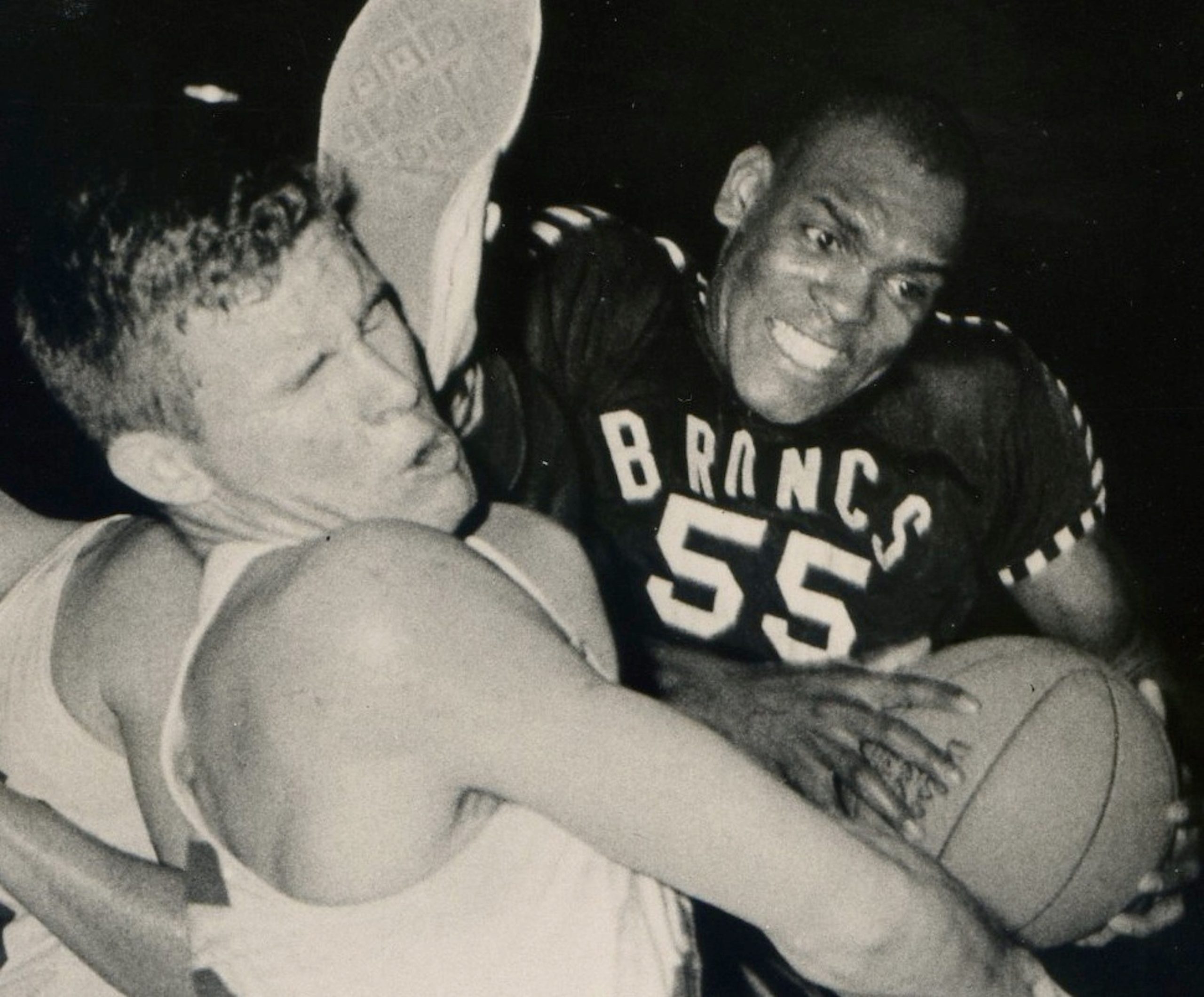
Lucious Jackson clears out some space under the basket as he hauls down a rebound during a game for the Pan American College Broncs. Jackson led the Broncs to the 1963 NAIA basketball title. – Courtesy photo, UT Rio Grande Valley